


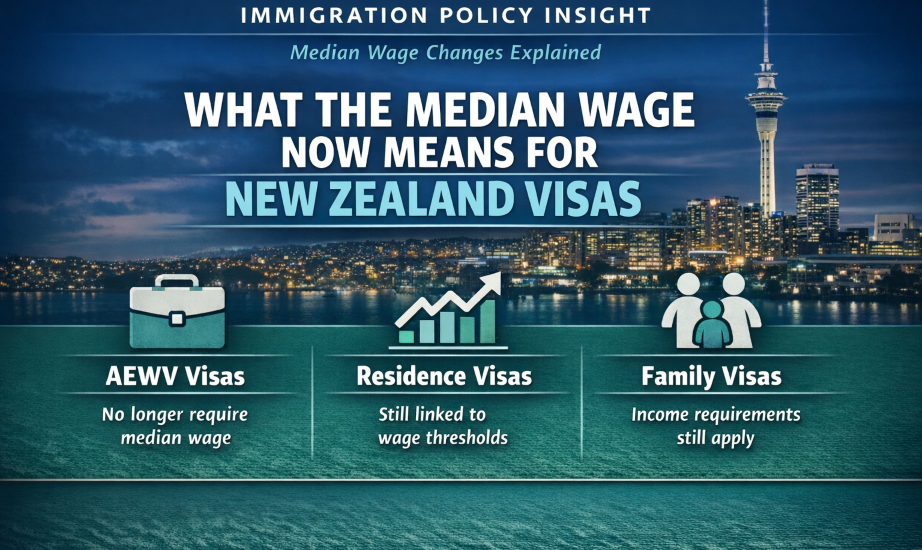
New Zealand’s immigration system has long used the median wage as a benchmark for determining visa eligibility, residence pathways, and family sponsorship requirements.
However, in recent years the role of the median wage has changed significantly, particularly following reforms to the Accredited Employer Work Visa (AEWV) system.
Understanding how the median wage works — and where it still applies — is critical for migrants, employers, and families planning their immigration pathway to New Zealand.
What Is the Immigration Median Wage?
The immigration median wage is based on Statistics New Zealand earnings data, which measures the midpoint of hourly wages across the labour market.
Immigration New Zealand has historically used this figure to determine:
-
Whether employment is considered skilled
-
Eligibility for residence pathways
-
Income requirements for supporting family members
Because the figure reflects real wage data across New Zealand, it changes periodically as wages across the economy increase.
For migrants planning to work in New Zealand, the median wage has traditionally been closely associated with the Accredited Employer Work Visa (AEWV) — the main work visa used by employers to hire migrant workers.
The Major Policy Change: Median Wage Removed for AEWV
One of the most significant immigration policy changes in recent years occurred when the government removed the median wage requirement for AEWV roles.
Previously, most migrant workers applying for an Accredited Employer Work Visa needed to be paid at least the median wage in order to qualify.
Under the current policy:
-
Employers no longer need to pay the median wage for most AEWV roles
-
Migrants must instead be paid the market rate for the job
-
Pay must still meet or exceed the New Zealand minimum wage
This change was introduced to provide greater flexibility for employers and better align migrant pay with actual labour market conditions.
For many sectors that traditionally pay below the national median wage, this change has significantly expanded the ability to recruit migrant workers.
Why the Median Wage Still Matters
Although the median wage is no longer required for most AEWV applications, it still plays an important role in several other immigration settings.
Many migrants assume the median wage is no longer relevant — but that is not the case.
Several visa categories and sponsorship requirements still rely on income thresholds linked to the median wage.
Residence Pathways
Many residence pathways in New Zealand still use wage thresholds linked to the median wage.
These include:
-
Skilled residence pathways
-
Some Green List residence categories
-
Work-to-residence visa routes
As the median wage increases, the income thresholds for these visas may increase as well.
Partner Visa Sponsorship
In some situations, a New Zealand resident or visa holder may need to demonstrate sufficient income when supporting a partner visa application.
While partner visas are primarily based on the genuine and stable relationship requirement, income thresholds can still arise in certain cases.
For example, where the partner sponsor must demonstrate the ability to support the applicant financially.
Supporting Dependent Children
Income requirements also apply when sponsoring dependent children under immigration policy.
Sponsors may need to demonstrate they earn a certain proportion of the median wage when supporting dependent children for visas.
As the median wage increases, these income thresholds may increase as well.
Market Rate Is Now the Key Factor
With the removal of the median wage requirement for AEWV visas, Immigration New Zealand now places much greater emphasis on market rate pay.
This means employers must demonstrate that the salary offered to a migrant worker is consistent with what a New Zealander would typically earn in the same role.
Evidence may include:
-
Industry salary data
-
Comparable job advertisements
-
Regional wage variations
-
Sector-specific pay levels
Immigration New Zealand assesses whether the job offer reflects the true market rate for that occupation.
If the salary appears artificially low, the visa application or Job Check may still be declined.
What This Means for Migrants and Employers
The removal of the median wage threshold has created both new opportunities and new responsibilities.
For Employers
Employers now have greater flexibility to recruit migrant workers for roles that may fall below the national median wage.
However, they must still demonstrate that the wage offered is genuine market rate pay.
For Migrants
Migrants should understand that while the AEWV no longer requires the median wage, income levels can still influence:
-
Residence eligibility
-
Family sponsorship
-
Visa pathways
Understanding these thresholds can be critical when planning a long-term immigration strategy.
The Future of Wage Settings in Immigration
Immigration policy continues to evolve.
The government has already begun introducing new frameworks, including the National Occupation List (NOL), which is gradually replacing ANZSCO classifications.
While the median wage requirement has been removed for AEWV applications, wage thresholds are still likely to play a role in future residence and sponsorship policies.
For migrants and employers, this means it is important to stay informed about how wage thresholds interact with different visa categories.
Key Takeaways
The median wage remains an important concept in New Zealand immigration policy, even though its role has changed.
Key points to remember:
-
The median wage is based on national earnings data from Statistics New Zealand
-
AEWV applications no longer require pay at the median wage
-
Migrant workers must still be paid market rate for the role
-
Some residence pathways still rely on median wage thresholds
-
Income requirements for supporting family members may also reference the median wage
Understanding how these policies interact is essential when planning a migration pathway to New Zealand.
Related Immigration Guides
You may also find these guides helpful: